Francine Van Meter
  • Home
  • About Me
  • Climate Stewardship

Fog  along  the  coast

Nature’s way of exhaling when hot air meets cool air.

Biofilm Festival in Big Basin State Park

3/12/2025

 
Picture
Currently, in Big Basin State Park, the reservation-only parking lot is covered with a substance that looks like an oily sheen, and has a "sulfur-like" smell in some areas.

Visitors have shared their thoughts about the smell, and many think it's a human-made event (like leakage from an old septic tank, etc.).
​
What is it? What are its characteristics? What does it remind us of?  Staff are currently gathering observations. Uncovering a mystery is always exciting, and challenges one's assumptions, and patience.
 

Here's what we know:
  1. Water bubbles out from underground at the interface of crushed rock/soil and the edge of the parking lot asphalt. The entire portion of this lot is covered with "slime."  Video of parking lot
  2. It has been observed during the rainy season, and dries up in early summer into early fall.
  3. It breaks apart like glass if you poke it with a stick. (Oil doesn't do this.) 
  4. In sunshine, it displays a rainbow-like sheen.
  5. Many areas appear to have an orange-rusty appearance. (Iron?)
  6. Some areas have a sulfur-like smell. (Bacteria-eating iron?)
  7. We're not sure this occurred before the 2020 CZU Lightning Complex Fire.  All structures in this vicinity were burned, and the parking lot is new.

Picture
Many areas display a white-ish sediment. Soil particles?
Picture
Rainbow sheen on the segmented pieces.
According to Justine Dees, a PhD in microbiology, bacteria living in water or sediments can change the form of metals like iron, manganese, and copper. 1 Some bacteria can change iron from a solid to dissolved, and back to solid again. Crazy, right?! Some bacteria ferment while growing…thus the stink!" "Microbial diversity also responds to changes in environmental variables, such as sun, temperature, and location." 2

The image below shows the shiny rainbow colors. If this is biofilm, it meets the characteristics of floating on top and ‘shattering' like glass when disturbed.  Stay tuned. The mystery of the post-fire, redwood forest, with a slimy parking lot, has yet to be uncovered!

Picture

The Amazing "All Purpose" Soap Root Plant!

2/24/2025


A River Runs Through It (Again)

2/19/2025

 
PG&E will decommission an old hydropower plant, remove its dam, and remove the Lake Pillsbury dam that sits on an active Fault Zone. Dams can disrupt natural water flow, leading to increased flooding in some areas and reduced water availability. Removing dams can help restore natural flow patterns, improving water management.
  • Eel River: Removing the Scott and Cape Horn dams on the Eel River will open up nearly 300 miles of historic spawning and rearing habitat for salmon and steelhead. 
  • Russian River: The agreement surrounding the Eel River dam removal also addresses water security for the Russian River watershed, by modernizing the water diversion system. 
Map below from Friends of the Eel River 

Picture

Winter in Santa Cruz County

1/31/2025

0 Comments

 
Winter in California has seen its share of extraordinary weather events and devastating losses from fire. In Santa Cruz County, there have been massive waves eroding the coastline and damaging seashore structures. There was even a tornado event that overturned cars in Scotts Valley. A related event occurred in Moss Landing when lithium-ion batteries burned at an energy storage plant, releasing clouds of microscopic particles of nickel, cobalt and manganese in the mudflats and tidal marshes at levels roughly 100 to 1,000 times higher than normal! Yikes!

Below are some soothing images from this winter. Mother Nature is indeed resilient, but we need to understand the messages she sends us, and work harder to protect what's left.
0 Comments

The Iconic Redwoods

10/26/2024

 
Picture
Eel River at Humboldt Redwoods State Park
Coast redwoods (sequoia sempervirens) are some of the most unique and versatile tree species on Earth. Their ancestors have been on the planet for around 245 million years! How do organisms survive this long?  How do plants and animals adapt over a gazillion years? They must mutate! Let's look at some mutations that are visually very odd!
Picture
In the image above, it looks like a redwood tree growing off another redwood tree. The living tissue of the cambium layer (beneath the bark) contains unsprouted bud tissue that carries the tree's genetic material. So when the branch sprouts, in some circumstances, it begins to grow like another tree, moving upward toward the sun.
     Coast Redwoods have a genetic makeup that’s nearly nine times larger than the human genome. The 3 species of sempervirens we see today, emerged between 65-36 million years ago; sempervirens, giganteum (Giant sequoia), and glyptostroboides (Dawn redwood). The earliest fossil record in California is found in rocks less than 20 million years old. (During the Miocene era)
Picture
Redwoods accumulate mutations at a high rate. The albino trees are an example.
Nearly white-leaved albinos are another mutation. They are that way because of a rare genetic mix-up. The tree and its needles lack chlorophyll. They survive largely as parasites, mooching off the parent tree with which they share roots. They also contain heavy metals like cadmium, copper, and nickel.
Picture
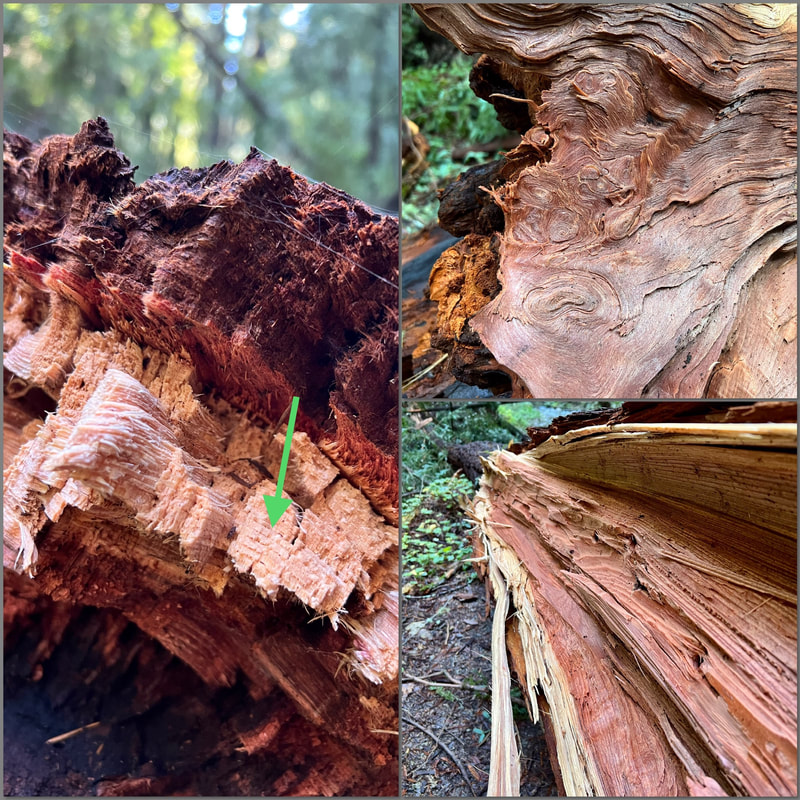
Genetic artistry in the redwood bark.
What causes horizontal wavy ridges or curls on the bark and interior of a few coastal redwoods? 
Don’t know. Most likely it's a genetic mutation. These patterns can also be seen by neighboring redwood trees growing out of the same root system (clonal group).

What plant has the most base pairs?
The itty bitty fern called Tmesipteris oblanceolata, pictured below. It has a whopping 160 billion base pairs in its DNA. ​The redwood has 26.5 base pairs in its DNA.

The researchers collected T. oblanceolata from the island nation of New Caledonia. It’s just a few inches tall. 
Picture
Photo credit: Pol Fernandez
<<Previous
Forward>>

    Categories

    All
    Climate
    Fire Ecology
    Plants
    Redwoods
    Travel
    Wildlife

    RSS Feed

  • Home
  • About Me
  • Climate Stewardship